Tuesday, 23 March 2010

TARDIS (Time And Relative Dimension(s) In Space)

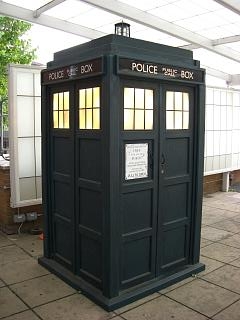
The TARDIS used from 2005-2010, on display at BBC Television Centre

A TARDIS is a product of the advanced technology of the Time Lords, an extraterrestrial civilisation to which the programme's central character, the Doctor, belongs. A properly maintained and piloted TARDIS can transport its occupants to any point in time and space. The interior of a TARDIS is much larger than its exterior, which can blend in with its surroundings through the ship's "chameleon circuit". In the series, the Doctor pilots an unreliable, obsolete Type 40 TARDIS, whose chameleon circuit is faulty, leaving it locked in the shape of a 1950s-style London police box after a visit to London in 1963. The Doctor's TARDIS was stolen from the Time Lords' home planet, Gallifrey, where it was old, decommissioned and derelict. The unpredictability of the TARDIS's short-range guidance—short relative to the size of the Universe—has often been a plot point in the Doctor's travels.
Although "TARDIS" is a type of craft, rather than a specific one, the Doctor's TARDIS is usually referred to as "the" TARDIS or, in some of the earlier serials, just as "the ship", "the capsule" or even "the police box". (In the two 1960s Dalek films, the craft was referred to as Tardis, without the definite article.)
Doctor Who has become so much a part of British popular culture that not only has the shape of the police box become more immediately associated with the TARDIS than with its real-world inspiration, the word "TARDIS" has been used to describe anything that seems bigger on the inside than on the outside. The name TARDIS is a registered trademark of the British Broadcasting Corporation.

Friday, 19 March 2010

Dalek


Daleks are organisms from the planet Skaro, integrated within a tank-like or robot-like mechanical casing. The resulting creatures are a powerful race bent on universal conquest and domination, utterly without pity, compassion or remorse. Various storylines portray them as having had every emotion removed except hate, leaving them with a desire to purge the Universe of all non-Dalek life. Very occasionally they are shown as experiencing other emotions, including fear, although such occurrences are rare.

Tuesday, 16 March 2010

Into the unknown...
...The Eleventh Doctor (Matt Smith)


The Eleventh Doctor is the eleventh and current incarnation of the fictional character known as the Doctor, who appeared on screen in the long-running BBC television science-fiction series Doctor Who beginning in 2010. Matt Smith plays this incarnation, replacing David Tennant's Tenth Doctor in the 2010 episode "The End of Time, Part Two".

Within the series' narrative, the Doctor is a centuries-old alien, a Time Lord from the planet Gallifrey, who travels in time and space in his TARDIS, frequently with companions. When the Doctor is critically injured, he can regenerate his body but in doing so gains a new physical appearance and with it, a distinct new personality. Smith portrays the eleventh such incarnation.


The Eleventh Doctor first appears in the final minutes of The End of Time (2010). The Tenth Doctor, succumbing to radiation poisoning, sets his TARDIS into orbit around the Earth and begins to regenerate. The regeneration energy causes the TARDIS's windows to shatter and the console room to burst into flames, parts of it even collapsing as a result. On regenerating, the Eleventh Doctor inspects his appearance — briefly panicking about his long hair in the belief that he has regenerated into a girl before innocently confirming otherwise — before realising that the TARDIS is crashing. He clings to the TARDIS console, shouting, "Geronimo!" as the TARDIS falls to Earth.

Speculation about the identity of the Eleventh Doctor began on 28 June 2008; the penultimate episode of the fourth series, "The Stolen Earth", ended as the Doctor was regenerating after being shot by a Dalek's death ray. The lack of a trailer for the second part, "Journey's End", prompted media and public speculation which helped Doctor Who attain the highest position in the weekly ratings in the show's history. The rumoured replacements included Catherine Tate (then playing the Doctor's companion Donna Noble), Robert Carlyle, Jason Statham, Alan Davies and James Nesbitt. The Daily Mail also reported the theories that two Doctors could be created—eventually proven to be correct—and that Tennant's announcement that he would leave in 2009 was a bluff to create a shock regeneration.
Karen Gillan as Amy Pond, with Matt Smith as the Eleventh Doctor (2009)

Tennant announced at the National Television Awards on 29 October 2008 that he would be stepping down from portraying the Doctor because he felt that the four years he spent portraying the character was enough and to ease the transition from Russell T Davies' showrunning to Steven Moffat's. At the time, BBC News published that Paterson Joseph, who appeared in the Doctor Who episodes "Bad Wolf" and "The Parting of the Ways", was the bookmaker's favourite to succeed Tennant and if chosen would become the first black Doctor, followed by David Morrissey, who would be appearing in the 2008 Christmas special, "The Next Doctor". Other candidates included Sean Pertwee, son of Third Doctor actor Jon Pertwee; Russell Tovey, who portrayed Alonzo Frame in the 2007 Christmas special, "Voyage of the Damned"; and James McAvoy.

Although Steven Moffat expected to pick a middle-aged actor for the new Doctor, at 26 years old, Smith will be the youngest actor to portray the Doctor, three years younger than Peter Davison was at the time he began his role as the fifth Doctor. Smith was one of the first actors to audition for the role, and the production team immediately singled him out based on his performance. Show producers were cautious about casting him because they felt that a 26-year-old could not play the Doctor adequately; BBC Wales Head of Drama Piers Wenger shared the sentiment, but noted that Smith was capable enough to play the role. Smith's casting in the role was revealed during an episode of Doctor Who's companion show Doctor Who Confidential, during which he described the role as "a wonderful privilege and challenge that I hope I will thrive on".

Smith's costume consists of a brown tweed jacket, rose shirt, dark brown braces, bow tie, rolled up navy trousers and black boots. A different coloured variation of this costume – still with the tweed jacket – can be seen in the trailer for Series 5; in addition, the trailer includes footage of the Doctor wearing the tattered suit of the Tenth Doctor in several scenes.

In an interview with Doctor Who Magazine, Steven Moffat revealed that the Eleventh Doctor had an entirely different costume until close to the start of filming. The original look had a piratical feel which Benjamin Cook described as "a little like something Captain Jack Sparrow wears in the Pirates of the Caribbean movies". However Matt Smith was unhappy with the costume as he felt it reflected how someone else would dress the Doctor, rather than how the Doctor would dress himself. The eventual costume, in particular the bow-tie, was influenced by Patrick Troughton's Second Doctor, after Matt Smith fell in love with the Troughton story The Tomb of the Cybermen.

Tuesday, 9 March 2010

The TENTH Doctor (David Tennant)

The Tenth Doctor is the tenth incarnation of the fictional character known as the Doctor seen on screen in the long-running BBC television science-fiction series Doctor Who. He is played by David Tennant, who replaced Christopher Eccleston's Ninth Doctor in the 2005 series finale, "The Parting of the Ways". Tennant appears in three series, as well as eight specials. As with previous incarnations of the Doctor, the character has also appeared in other Doctor Who multimedia.

In the series' narrative, the Doctor is a centuries-old Time Lord alien from the planet Gallifrey who travels in time in his TARDIS, frequently with companions. When the Doctor is critically injured, he can regenerate his body; in doing so, his physical appearance and personality change. Tennant portrays the tenth such incarnation. His companions include Rose Tyler (Billie Piper), who was already travelling with his predecessor; Martha Jones (Freema Agyeman) and Donna Noble (Catherine Tate), but he eventually parts ways with them all by the end of the 2008 series finale, "Journey's End". Wilfred Mott (Bernard Cribbins) briefly serves as his companion during the events of the 2009 two-part special "The End of Time".

During an acceptance speech of a 2008 National Television Award for his role as the Tenth Doctor, David Tennant announced that he would not be returning as the intrepid Time Lord for the fifth series, scheduled to be broadcast in 2010. He made his final appearance as the Doctor in The End of Time.

In 2009, Doctor Who Magazine readers voted the Tenth Doctor as Number One in Issue 414's Favorite Doctor poll, winning 25.64% of the vote, beating the Fourth Doctor (Tom Baker) who came in at number 2 with 24.73% of recorded votes.

After the successful premiere of "Rose" and announcement of a second series being commissioned by the BBC, the story broke that Christopher Eccleston, who played the Ninth Doctor, would not be returning for the second series. On 16 April 2005, the BBC announced that David Tennant had been selected for the role of the Tenth Doctor. His first appearance in the series was for 20 seconds following the Ninth Doctor's regeneration at the end of "The Parting of the Ways". His first full episode as the Doctor, barring an appearance in a "mini-episode" during the 2005 Children in Need show, was the 2005 Christmas Special, "The Christmas Invasion". He then appeared in the 2006 series, the second seasonal episode, the 2007 series, the third Christmas special, and the 2008 series. Rather than a traditional series run, 2009 features a series of five specials and a series of animated shorts, all starring Tennant as the Tenth Doctor; he also guest-starred in a two-episode serial of The Sarah Jane Adventures spin-off in that year.

In 2006, readers of Doctor Who Magazine voted Tennant's Doctor "Best Doctor" over perennial favourite Tom Baker.

A thirteen-part animated adventure, The Infinite Quest, featuring the Tenth Doctor and companion Martha Jones (voiced by David Tennant and Freema Agyeman) premiered on Totally Doctor Who on 2 April 2007; the last segment of The Infinite Quest was shown with all previous episodes as an entire Doctor Who episode on 30 June 2007. The Tenth Doctor also appeared in a second animated serial, Dreamland, aired on CBBC in Autumn 2009.

While the previous Doctor was never explicitly referred to as the Ninth on-screen, the exact number of incarnations thus far was confirmed in-series by sketches of the ten Doctors to date in the sketchbook A Journal of Impossible Things that appeared in 2007's "Human Nature" (although only five incarnations are visible on-screen, the other five also appear on a two-page scan seen on the BBC's tie-in website). In "School Reunion", the Tenth Doctor commented to Sarah Jane Smith that he had regenerated half a dozen times since they had last met; Sarah last saw the Doctor at the end of the Fourth Doctor serial The Hand of Fear (in the anniversary special "The Five Doctors" (1983), she is paired up with the Third Doctor, and also meets the Fifth Doctor, Second Doctor, and First Doctor). Off-screen, on the DVD commentary for "The Parting of the Ways", Julie Gardner states after the regeneration sequence, "Tennant is Ten!". For the soundtrack of "The Christmas Invasion", a specially commissioned piece played during the sequence in which the Doctor chooses his new outfit was titled "Song for Ten". The BBC's official website refers to Tennant's Doctor as the "Tenth Doctor", as do all promotional materials for the show, such as trading cards and action figures.


The Ninth Doctor regenerates into the Tenth Doctor due to cellular damage caused by absorbing the energies of the time vortex at the climax of "The Parting of the Ways". In the untitled Children in Need mini-episode, the Doctor initially exhibits stable behaviour as he introduces his new form to Rose Tyler, showing particular interest in his appearance, but soon begins acting erratically and says that his regeneration has "gone wrong". He remains in a delirious or comatose state through most of the events of "The Christmas Invasion" until his regeneration is settled through absorbing the free radicals and tannin from some hot tea that had dripped onto a power source inside the TARDIS. He then saves the Earth from invasion by killing the leader of the alien Sycorax using a satsuma when he refuses to leave peacefully ("No second chances; I'm that sort of a man", he remarks). The Doctor's right hand is severed in the fight, although he regenerates a new one since his regeneration cycle was not fully completed.

The Tenth Doctor and Rose go on to meet Queen Victoria, saving her from a werewolf which resulted in not only the Doctor's knighting as "Sir Doctor of TARDIS" and banishment from the British Empire, but also resulted in the creation of the Torchwood Institute, an Earth organization dedicated to policing supernatural and alien affairs. After being reunited with his previous incarnation's companion, Sarah Jane Smith, the Doctor, Rose, and Mickey Smith end up in an alternate universe where the Cybermen originate on Earth. After stopping them, the Doctor leaves Mickey behind at his request. During the 2-part event of "The Impossible Planet" and "The Satan Pit", the Doctor encounters the Torchwood Archive as they unknowingly awakened the Beast, who spoke of Rose's death to her shock as the Doctor assures her that it was only words. But the Beast's prophecy comes true when the Doctor eventually returns to present-day Earth, his TARDIS is stolen by the Torchwood Institute, who are manipulated by the Cybermen into creating a link to their universe through the Void, which inadvertently frees the Dalek Empire from the Time War as well. The Torchwood Institute forms a truce with the Cybermen until the Daleks are returned to the Void, at the cost of Torchwood's main base, the scattering of the Cybermen through time and space, and Rose, believed dead to the general public, ending up at the alternate universe with her mother and Mickey.

Immediately after the loss of Rose, who was in love with him, the Doctor meets Donna Noble, a bride drawn to the TARDIS during her wedding by a poisonous energy administered to her by the Racnoss, a race of spider aliens that had been hibernating in the Earth's core and needed to use Donna as a key to release themselves. The Doctor cures Donna and murders the Racnoss Queen and her brood, planning to die with them until Donna saves him. The Doctor offers Donna companionship, which she refuses but she suggests the Doctor finds someone who can "stop [him] sometimes". The Doctor later saves Martha Jones from an alien vampire pursued by the Judoon, and brings her on his various adventures, one of which has him meet the Face of Boe before his death and hearing his final worlds, "You Are Not Alone". In the far, far future, near the Heat death of the universe, after the TARDIS attempted to shake off Captain Jack Harkness, the Doctor learns the meaning behind the Face of Boe's final worlds when he and Martha inadvertently free the Master from a Chameleon Arch. The Master immediately steals the TARDIS and regenerates, returning to Earth in 2006 and becoming Prime Minister of the United Kingdom. When the Doctor and Martha return, hitching a ride on Jack's Vortex Manipulator, the Master captures the Doctor and Jack, using them to enslave the human race. Martha escapes capture and attempts to undermine the Master. With Martha's help, the Doctor eventually defeats the Master and reverses the year during which he nearly destroyed the universe. After the universe is safe, the Master is shot and dies in the Doctor's arms.

After Martha and Jack's departure in the aftermath of the Master's death, the Doctor finds himself on a replica of the Titanic and keeps it from crashing onto London on Christmas Day. Soon after, the Doctor once more crosses paths with Donna, who accepts his offer and becomes his companion. Throughout their journey to places like Pompeii and the Planet of the Ood, the Doctor and Donna receive cryptic mentions of their future as well as equally mysterious appearances of Rose. After helping Martha and UNIT against the Sontarans, the TARDIS takes the Doctor, Donna, and a confused Martha to the planet Messaline in an unknown time period where the armed human colonists' forceful extrapolation of the Doctor's DNA results in the birth of Jenny, whom the Doctor eventually accepts as his 'daughter,' only to be separated from her by the end of the episode after he believes her to have died, not knowing that she later returned to life once he left.

In the aftermath of "Turn Left" and as The Stolen Earth begins, the Doctor is warned by Rose through Donna that the world is endangered. Finding the Earth gone, the Doctor contacts the Shadow Proclamation, learning that Earth is the latest of a series of planets that vanished. With the aid of the Doctor's former companions Captain Jack, Martha and Sarah Jane Smith, the Doctor pinpoints their location and learns that Davros is the cause of the planets' disappearance. The Doctor arrives on Earth where Rose is waiting for him, however before they are reunited, the Doctor is mortally shot by a Dalek, evoking his regeneration which he manages to redirect towards his previously severed hand that is connected to the TARDIS, keeping the Doctor in the same form. That action led to Donna inadvertently causing a "human biological metacrisis" by touching the severed hand, causing her to manifest into a Time Lord/human hybrid version of the Tenth Doctor to be created as well as Donna's eventual transformation into the predicted Doctor Donna that led to the Daleks' defeat and the worlds returned to their rightful places. After saying goodbye to his former companions, the Doctor is forced to erase Donna's memories when the Time Lord energy within her starts to consume her and leaves her behind as he departs in the TARDIS by himself. In the following special episode, "Music of the Spheres", his musical talent is revealed, when he has taken his mind off his loneliness by composing an "Ode to the Universe".

In "Planet of the Dead", after returning stranded humans from San Helios, the Doctor is told of a premonition: "Your song is ending, sir. It is returning, it is returning through the dark. And then Doctor... oh, but then...he will knock four times", an event which will precede his death. It starts to become a reality during "The End of Time", when the Master is resurrected and rewrites humanity's genetic makeup in his own image, as an unwitting part of a plan designed to enable the Time Lords to escape their fate at the end of the Time War. After the Master and the Time Lords are stopped and the planet is safe, the Doctor finds his companion, Wilfred Mott, locked in a containment chamber in danger of imminent fatal contamination. Wilf knocks four times to alert the Doctor to his situation. Though raging against the universe for his fate, the Doctor nevertheless enters the cubicle to save Wilf, causing himself to suffer a lethal dose of radiation poisoning. The Doctor spends the remainder of his life paying final visits to his past companions, his last being Rose Tyler in a time before she met his previous incarnation. Dying a slow death, the Doctor sets a new course in the TARDIS before he begins to regenerate, his last words being "I don't want to go". With a massive release of energy that cripples his ship, he regenerates into the Eleventh Doctor.

Wednesday, 3 March 2010

The Ninth Doctor (Christopher Eccleston)

The Ninth Doctor is the ninth official incarnation of the fictional character known as the Doctor, in the long-running BBC television science-fiction series Doctor Who. He is played by Christopher Eccleston.

"Unofficial" Ninth Doctors include the Ninth Doctor played by Rowan Atkinson in the charity parody Doctor Who and the Curse of Fatal Death and the Ninth Doctor voiced by Richard E. Grant in the animated webcast Scream of the Shalka (to avoid confusion with Eccleston's incarnation Grant's Doctor is referred to as the Shalka Doctor by fans). This article is about the official Ninth Doctor, whose tenure as the Doctor made up series 1 of the revived programme in 2005.

Within the series' narrative, the Doctor is a centuries-old alien, a Time Lord from the planet Gallifrey, who travels in time in his TARDIS, frequently with companions. When the Doctor is critically injured, he can regenerate his body but in doing so gains a new physical appearance and with it, a distinct new personality. Eccleston portrays the ninth such incarnation, a brooding and melancholic war survivor after a Time War in which he wiped out both his race and the enemy Daleks. His first companion is Rose (Billie Piper), whom he plucks from obscurity on the planet Earth and to whom he grows increasingly attached. Eccleston's Doctor also travels briefly with unruly boy-genius Adam (Bruno Langley) and with 51st century con man and former 'Time Agent' Captain Jack Harkness (John Barrowman).

The original Doctor Who television series ceased production in 1989 with the Seventh Doctor. The Eighth Doctor, Paul McGann appeared in the role just once on screen in the Doctor Who television movie in 1996. The appearance of the Ninth Doctor marked the regular return of the character to television screens after nearly sixteen years, and as a result for many young fans and new viewers he was the first Doctor they had ever seen. He was introduced without any information on his recent past; though it is implied in "Rose" that he may have recently regenerated, the exact circumstances of that change, or what caused it, are unknown.

Friday, 26 February 2010

The Eighth Doctor (Paul McGann)

The Eighth Doctor is a fictional character, the eighth incarnation of the Doctor seen on screen in the long-running BBC television science-fiction series Doctor Who. He was portrayed by Paul McGann. Though he appeared in only one TV feature, his adventures are extensively portrayed in other media.

Within the series' narrative, the Doctor is a centuries-old alien, a Time Lord from the planet Gallifrey, who travels in time in his TARDIS, frequently with companions. When the Doctor is critically injured, he can regenerate his body but in doing so gains a new physical appearance and with it, a distinct new personality. McGann portrays the eighth such incarnation, a passionate, enthusiastic and eccentric character. His only companion in the television movie is Grace Holloway (Daphne Ashbrook), a medical doctor whose surgery is responsible for triggering his regeneration. In the continued adventures of the character depicted in audio dramas, novels and comic books he travels alongside numerous other companions, including self styled "Edwardian Adventuress" Charley, the alien Destrii and present-day humans Lucie and Sam.

The Eighth Doctor is the first since the original incarnation (portrayed by the late William Hartnell) not to have his face appear in the opening title sequence. This trend would continue throughout the revived series with the Ninth and Tenth Doctors.

The Eighth Doctor made his first and only television appearance in the 1996 Doctor Who television movie, the first time the Doctor had returned to television screens since the end of the original series in 1989. Intended as a backdoor pilot for a new television series on the Fox Network, the movie was inadequately marketed and advertised (and in some markets even pre-empted by televised sporting events), ultimately leading to poor US ratings. In the UK, however, it was received well, attracting over 9 million viewers and generally positive reviews. It was also generally well received in Australia.

Although the movie failed to spark a new television series, the Eighth Doctor's adventures continued in various licensed spin-off media, notably BBC Books' Eighth Doctor Adventures novels, audio plays from Big Finish Productions, and the Doctor Who Magazine comic strip. As these stories spanned the nine years between 1996 and the debut of the new television series in 2005, some consider the Eighth Doctor one of the longest-serving of the Doctors. He is unarguably the longest-serving Doctor in the Doctor Who Magazine comic strip. In the wake of the positive reaction to the revived television series in 2005, several of the Eighth Doctor's Big Finish audio dramas were also broadcast on BBC7 radio in an edited form. The trailers for these broadcasts explained that these adventures took place before the destruction of Gallifrey as described in the revived TV series. In 2007, the BBC7 aired a new series of Eighth Doctor audio adventures, created specifically for radio broadcast. Paul McGann has continued to portray the Eighth Doctor in the various audio spinoffs.

The canonicity of the spin-off media with respect to the television series and to each other is open to interpretation (the "Beginner's Guide to Doctor Who" on the BBC's classic Doctor Who website suggests this may be due to the Time War). It has been suggested that the Eighth Doctor's adventures in three different forms (novels, audio, and comics) take place in three separate continuities. The discontinuities were made explicit in the audio drama Zagreus. In response, it has become increasingly common to consider the three ranges separately. The final Eighth Doctor Adventures novel, The Gallifrey Chronicles, obliquely references this split in timelines, even suggesting that the split results in the three alternative forms of the Ninth Doctor (a reference to the fact three different versions of the incarnation have appeared in various media). Even so, all matters of canonicity remain typically unclear.

Despite the fact the Eighth Doctor appeared on television only once, he is the most prolific of all the Doctors (to date) in terms of number of individual stories published in novel, novella, short story and audio form. In 2007, the Eighth Doctor finally made a second appearance (of sorts) within the television series' continuity. In the episode "Human Nature" he appears on-screen as a sketch (alongside other incarnations) in the book A Journal of Impossible Things by John Smith. In 2008 he appeared again as a brief image in "The Next Doctor" along with every other incarnation up to that time.

Saturday, 20 February 2010

The Seventh Doctor (Sylvester McCoy)

The Seventh Doctor is a fictional character, the seventh incarnation of the Doctor seen on screen in the long-running BBC television science-fiction series Doctor Who. He was portrayed by the actor Sylvester McCoy.

Within the series' narrative, the Doctor is a centuries-old Time Lord alien from the planet Gallifrey who travels in time and space in his TARDIS, frequently with companions. When the Doctor is critically injured, he can regenerate his body; in doing so, his physical appearance and personality change. McCoy portrays the seventh such incarnation, a whimsical, thoughtful character who quickly becomes more layered, secretive and manipulative. His first companion was Melanie Bush (Bonnie Langford), a computer programmer who travelled with his previous self, and who is soon succeeded by troubled teenager and explosives expert Ace (Sophie Aldred), who becomes his protégé.

In his first season, the Seventh Doctor started out as a comical character, mixing his metaphors ("Time and tide melt the snowman," for example), playing the spoons, and making pratfalls, but soon started to develop a darker nature and raised the profound question of who the Doctor actually is. The Seventh Doctor era is noted for the cancellation of Doctor Who after 26 years. It is also noted for the Virgin New Adventures, a range of original novels published from 1992 to 1997, taking the series on beyond the television serials.

In 1990, readers of Doctor Who Magazine voted McCoy's Doctor "Best Doctor", over perennial favourite Tom Baker.

The Seventh Doctor's final appearance on television was in the 1996 Doctor Who television movie, where he regenerated into the Eighth Doctor, played by Paul McGann. A sketch of him is later seen in John Smith's A Journal of Impossible Things in the new series 2007 episode "Human Nature". A brief holographic clip of the Seventh Doctor appears in "The Next Doctor".

When the TARDIS was attacked by the Rani, the Sixth Doctor was injured and forced to regenerate. After a brief period of post-regenerative confusion and amnesia (chemically induced by the Rani), the Seventh Doctor thwarted the Rani's plans, and rejoined his companion Mel for whimsical adventures in an odd tower block and a Welsh holiday camp in the 1950s.

On the planet Svartos, Mel decided to leave the Doctor's company for that of intergalactic rogue Sabalom Glitz. Also at this time, the Doctor was joined by time-stranded teenager Ace. Although he did not mention it at the time, the Doctor soon recognised that an old enemy from a past adventure, the ancient entity known as Fenric, was responsible for the Time Storm which transported Ace from 1980s Perivale to Svartos in the distant future. Growing more secretive and driven from this point on, the Doctor took Ace under his wing and began teaching her about the universe, all the while keeping an eye out for Fenric's plot. The Doctor began taking a more scheming and proactive approach to defeating evil, using the Gallifreyan stellar manipulator named the Hand of Omega as part of an elaborate trap for the Daleks which resulted in the destruction of their home planet, Skaro. Soon afterwards, the Doctor used a similar tactic and another Time Lord relic to destroy a Cyberman fleet. He engineered the fall of the oppressive government of a future human colony in a single night and encountered the Gods of Ragnarok at a circus on the planet Segonax, whom he had apparently fought throughout time. Later, he was reunited with his old friend, Brigadier Lethbridge-Stewart while battling the forces of an alternate dimension on Earth.

The Seventh Doctor's manipulations were not reserved for his enemies. With the goal of helping Ace confront her past, he took her to a Victorian house in her home town of Perivale in 1883 which she had burned down in 1983. Eventually, the Doctor confronted and defeated Fenric at a British naval base during World War II, revealing Fenric's part in Ace's history. The Doctor continued to act as Ace's mentor, returning her to Perivale; however, she chose to continue travelling with him. The circumstances of her parting from the Doctor were not shown on television.

Near the end of his incarnation, the Seventh Doctor was given the responsibility of transporting the remains of his former enemy the Master from Skaro to Gallifrey. This proved to be a huge mistake: despite having a limited physical form, the Master was able to take control of the Doctor's TARDIS and cause it to land in 1999 San Francisco, where the Doctor was shot in the middle of a gang shoot-out. He was taken to a hospital, where surgeons removed the bullets but mistook the Doctor's double heartbeat for fibrillation; their attempt to save his life instead caused the Doctor to "die" with one last shocking scream. Perhaps due to the anesthesia, the Doctor did not regenerate immediately after death (unlike all previous occasions); he finally did so several hours later, while lying in the hospital's morgue.

In Time and the Rani the Seventh Doctor gives his age soon after his regeneration as "exactly" 953 years, indicating that some two centuries of subjective time has passed since his fourth incarnation was revealed to be 759 in The Ribos Operation, and approximately half-a-century since Revelation of the Daleks in which the Sixth Doctor stated he was 900 years old. The later revival of the series, however, has contradicted the age given by the Seventh Doctor (and the Sixth) by establishing the Ninth Doctor as 900 years old, with the Tenth Doctor stating his exact age as 903 in Voyage of the Damned and 906 in The End of Time.

Wednesday, 17 February 2010

The Sixth Doctor (Colin Baker)

The Sixth Doctor is the name given to the sixth incarnation of the fictional character known as the Doctor, seen on screen in the long-running BBC television science-fiction series Doctor Who.

He was portrayed by actor Colin Baker, and a cameo by Sylvester McCoy underneath a curly wig during the Sixth Doctor's regeneration scene into the Seventh where McCoy's face is not even seen unblocked as the Sixth Doctor.

This technically makes the Sixth Doctor one of only two incarnations of the Doctor to have been officially played by more than one actor, the other being the First Doctor.

Within the series' narrative, the Doctor is a centuries-old Time Lord alien from the planet Gallifrey who travels in time and space in his TARDIS, frequently with companions.

When the Doctor is critically injured, he can regenerate his body; in doing so, his physical appearance and personality change.

Although his televisual time on the series was comparatively brief and turbulent, Baker has gone on to find consistent critical acclaim as the Sixth Doctor in Big Finish's range of original Doctor Who audio adventures.

The Sixth Doctor's brightly coloured, mismatched clothes and brash, overbearing personality set him apart from all his previous incarnations, in some ways hearkening back to the early irascibility and undertones of untrustworthiness of the First Doctor.

The Sixth Doctor appeared in three seasons; however, in his first outing in Season 21 he appeared only in the final episode of The Caves of Androzani which featured the regeneration from the Fifth Doctor and thereafter in the following serial The Twin Dilemma to end that season.

The Sixth Doctor's era is noted for the decision of the BBC controller Michael Grade to put the series on an 18-month hiatus between seasons 22 and 23, with only one new Doctor Who story, Slipback, made on radio during the hiatus, broadcast as 6 parts (at 10 minutes each) on BBC Radio 4 from 25 July to 8 August 1985, as part of a children's magazine show called Pirate Radio Four.

He also appeared in the special Dimensions in Time. There are also novels and audio plays featuring the Sixth Doctor. A glimpse of a sketch of the Sixth Doctor was later seen in John Smith's A Journal of Impossible Things in the revived third series episode "Human Nature". A brief holographic clip of the Sixth Doctor appears in "The Next Doctor".

Friday, 12 February 2010

The Fifth Doctor (Peter Davison)

The Fifth Doctor is the name given to the fifth incarnation of the fictional character known as the Doctor seen on screen in the long-running BBC television science-fiction series Doctor Who. He was portrayed by actor Peter Davison.

Within the series' narrative, the Doctor is a centuries-old Time Lord alien from the planet Gallifrey who travels in time and space in his TARDIS, frequently with companions. When the Doctor is critically injured, he can regenerate his body; in doing so, his physical appearance and personality change.

The Fourth Doctor's regeneration into the Fifth was a problematic one, and nearly failed, with the Doctor briefly taking on personality aspects from his four previous incarnations. After recovering in the fictional city Castrovalva, he continued his travels with Tegan Jovanka, Nyssa and Adric. After trips to the future and the past encountering villains such as Monarch and the Mara, the Fifth Doctor was confronted with tragedy when Adric died trying to stop a space freighter from crashing into prehistoric Earth (Earthshock).

When the Doctor met a new companion, an alien boy stranded on Earth by the name of Vislor Turlough, he did not know that Turlough had been commissioned by the Black Guardian to kill him. Soon after, Nyssa left to help cure Lazar's Disease on the space station Terminus. After meeting the entities known as Eternals racing in yacht-like spacecraft for the prize of "Enlightenment", Turlough broke free from the Black Guardian's influence, and continued to travel with the Doctor and Tegan. The Doctor met three of his previous incarnations when they were summoned to the Death Zone on Gallifrey by President Borusa, who was attempting to gain Rassilon's secret of immortality.

After further adventures in which the Doctor re-encountered old foes including the Silurians and the Sea Devils both Tegan and Turlough left the TARDIS. Tegan would find the death and violence they encountered on their travels too much to bear (Resurrection of the Daleks), and Turlough returned to his home planet of Trion in the company of his younger brother, as well as other exiles of Trion, from the planet Sarn (Planet of Fire).

Ultimately, the Fifth Doctor and his last companion Peri Brown were exposed to the drug spectrox in its deadly toxic raw form on Androzani Minor. With only one dose of the antidote available, he nobly sacrificed his own existence to save Peri, regenerating into the Sixth Doctor, expressing doubt for the first time that regeneration might be possible.

A sketch of the Fifth Doctor is seen in John Smith's book in the new series episode "Human Nature".

Somewhere in his life (perhaps set after the events of Snakedance) he crashed his TARDIS into the TARDIS of the Tenth Doctor and consequently nearly opened a "Belgium sized" black hole because of the paradox caused, which the Tenth Doctor also uses to explain the notably aged appearance of his former self. However the Tenth Doctor, remembering the event, knew how to stop it because he recalled watching himself correct the mistake when he was the Fifth Doctor. ("Time Crash")

Tuesday, 9 February 2010

The Fourth Doctor (Tom Baker)

The Fourth Doctor is the name given to the fourth incarnation of the fictional character known as the Doctor in the long-running BBC television science-fiction series Doctor Who. He was portrayed by Tom Baker for seven consecutive years, and remains the longest-lived incarnation in the show's on-screen history. For audiences in the United States, who saw the show only in syndication (mostly on PBS), it was this incarnation of the Doctor who is the best known, as his episodes were the ones most frequently broadcast stateside.
Within the series' narrative, the Doctor is a centuries-old Time Lord alien from the planet Gallifrey who travels in time and space in his TARDIS, frequently with companions. When the Doctor is critically injured, he can regenerate his body; in doing so, his physical

The Fourth Doctor's eccentric style of dress and speech — particularly his trademark long scarf and fondness for jelly babies — made him an immediately recognisable figure and he quickly captivated the viewing public's imagination. This incarnation is generally regarded as the most recognisable of the Doctors and one of the most popular, especially in the United States. In polls conducted by Doctor Who Magazine, Tom Baker has lost the "Best Doctor" category only twice: once to Sylvester McCoy (the Seventh Doctor) in 1990, and once to David Tennant (the Tenth Doctor) in 2006.

The Fourth Doctor appeared in seven consecutive seasons over a seven-year period, from 1974 to 1981, making him the longest running Doctor on screen. He also appeared in the specials The Five Doctors (via footage from the uncompleted Shada) and Dimensions in Time, Tom Baker's last appearance in-character as the Doctor (aside from a series of television advertisements in New Zealand in 1997).

There are also novels and audio plays featuring the Fourth Doctor. Two early audio plays featuring Tom Baker voicing the Fourth Doctor date from Baker's television tenure as he had mainly declined to appear in any further audio plays since leaving the series. In 2009, however, it was announced that a new five part series would be produced by BBC Audio (see below).

After contracting radiation poisoning on the planet Metebelis 3, the Third Doctor makes his way back to UNIT headquarters, where the Time Lord K'Anpo Rimpoche aids him in regenerating (Planet of the Spiders).

In his new incarnation, the Doctor draws back from continuous involvement with UNIT (with which he had worked closely as the Third Doctor) and the Time Lords. The Time Lords continue to send him on occasional missions, including an attempt to prevent the creation of the Daleks (Genesis of the Daleks), during which he also meets a new adversary, Davros. The Doctor travels with journalist Sarah Jane Smith, whom he had befriended prior to his regeneration, and, for a time, with UNIT Surgeon-Lieutenant Harry Sullivan.

The Doctor's companionship with Sarah Jane is ended when he receives a telepathic summons to Gallifrey, as humans were not then allowed on the planet. The summons is part of a trap set by his enemy the Master, who has used up all his regenerations and become little more than a withered husk. The Master frames the Doctor for the assassination of the President of the High Council of Time Lords. In order to avoid execution, the Doctor invokes an obscure law and declares himself a candidate for the office, giving himself the time he needs to defeat the Master (The Deadly Assassin).

The Doctor is seen to travel alone for the first time since season 1, returning to a planet he had visited centuries before. During his previous visit, he had accidentally imprinted a human colony ship's powerful computer, Xoanon, with his own mind, leaving it with multiple personalities. On his second visit the Doctor is remembered as an evil god by the descendants of the colonists, some of whom had become a warrior tribe called the Sevateem. After the Doctor cures the computer, one of the Sevateem, Leela, joins him on his travels (The Face of Evil). The Doctor brings the intelligent but uneducated Leela to many locales in human history, teaching her about science and her own species' past. In Victorian London, the pair encounters the magician Li Hsien Chang and his master, the self-styled Weng-Chiang (The Talons of Weng-Chiang). Later, the Doctor and Leela visit the Bi-Al Foundation medical centre, where they acquire the robot dog K-9 (The Invisible Enemy).

The Doctor returns to Gallifrey and declared himself Lord President, based on the election held during his previous visit. This is a ploy to reveal and defeat a Sontaran invasion plan. Leela and K-9 decide to remain on Gallifrey; the Doctor comforts himself by producing K-9 Mark II (The Invasion of Time).

Shortly afterwards, the powerful White Guardian assigns the Doctor to find the six segments of the Key to Time, sending a young Time Lady named Romana to assist him. The two Gallifreyans find the six segments and defeat the equally powerful Black Guardian, who sought the Key for himself. After the conclusion of the quest, Romana regenerates into a new form (Destiny of the Daleks).

For a time, the Fourth Doctor and the second incarnation of Romana travel in another universe known as E-Space. There, they are joined by the young prodigy Adric. When the Doctor finds a way to leave E-Space, Romana and K-9 Mark II choose to remain behind. Adric and the Doctor are joined by the aristocratic orphan Nyssa of Traken and, in the Fourth Doctor's last adventure, by the opinionated Tegan Jovanka.

The conduit between E-Space and our own universe is revealed to be a Charged Vacuum Emboitment (CVE) — created by the mathematicians of Logopolis as part of a system to allow the Universe to continue on past its point of heat death. As he investigates this, the Fourth Doctor begins experiencing ominous feelings and spots a white-clad entity, "The Watcher," observing him. After succeeding in stopping the Master from disrupting the CVEs and destroying the universe, the Fourth Doctor is mortally wounded when he falls from the Pharos Project radio telescope control tower, where he utters his last words: "It's the end -- but the moment has been prepared for." The Watcher is revealed as a manifestation of the Doctor's future incarnation. Before the eyes of the Doctor's companions, the Watcher merges with the Fourth Doctor, regenerating him into the Fifth Doctor.

The Fourth Doctor appears once more in the 20th anniversary special The Five Doctors. A renegade Time Lord attempts to pull the first five incarnations of the Doctor out of time, inadvertently trapping the Fourth Doctor (and Romana) in a "time eddy" from which they are later freed. A brief holographic clip of the Fourth Doctor appears in "The Next Doctor".


Saturday, 6 February 2010

The Third Doctor (John Pertwee)

The Third Doctor is the name given to the third incarnation of the fictional character known as the Doctor; seen on screen in the long-running BBC television science-fiction series Doctor Who. He was portrayed by actor Jon Pertwee.

Within the series' narrative, the Doctor is a centuries-old Time Lord alien from the planet Gallifrey who travels in time and space in his TARDIS, frequently with companions. When the Doctor is critically injured, his body automatically regenerates; as a result, his physical appearance and personality change.

The Third Doctor was a suave, dapper, and authoritative man of action, who not only practiced Venusian Aikido (or Karate), but enjoyed working on gadgets and riding all manner of vehicles, such as the Whomobile and his pride and joy, the canary-yellow vintage roadster nicknamed "Bessie" which featured such modifications as a remote control, dramatically increased speed capabilities and even inertial dampeners.

While this incarnation spent most of his time exiled on Earth, where he grudgingly worked as UNIT's scientific advisor, he would occasionally be sent on covert missions by the Time Lords, where he would often act as a reluctant mediator. Even though he developed a fondness for Earthlings with whom he worked (such as Liz Shaw and Jo Grant), he would jump at any chance to return to the stars with the enthusiasm of a far younger man than himself (as can be seen in his frivolous attitude in The Mutants). If this Doctor had a somewhat patrician and authoritarian air, he was just as quick to criticise authority too—having little patience with self-inflated bureaucrats, parochially-narrow ministers, knee-jerk militarists or red tape in general. His courageousness could easily turn to waspish indignation. It is thus no surprise that a common catchphrase of his was, "Now listen to me."

Despite his arrogance, the Third Doctor genuinely cared for his companions in a paternal fashion, and even held a thinly-veiled but grudging admiration for his nemesis, the Master, and for UNIT's leader, Brigadier Lethbridge-Stewart, with whom he eventually became friends. In fact, even when his much resented exile was lifted, the highly moral and dashing Third Doctor continued to help UNIT protect the Earth from all manner of alien threats.

In general, this incarnation of the Doctor was more physically daring than the previous two, and was the first to attack an enemy physically if cornered (both of his previous incarnations would nearly always attempt to dodge, flee or negotiate rather than directly defend themselves). This often took the form of quick strikes, with the occasional joint lock or throw - usually enough to get himself and anyone accompanying him out of immediate danger - but usually not to the extent of a brawl, in keeping with the Doctor's non-violent nature. He would only use his fighting skills if he had no alternative, and even then generally disarmed his opponents rather than knock them unconscious. Indeed, his martial prowess was such that a single, sudden strike was usually enough to halt whatever threatened him, and at one point he reminded Captain Yates (physically as well as verbally) that Yates would have a difficult time removing him from somewhere when he did not want to be removed (The Mind of Evil).

Perhaps due to his time spent on Earth, or maybe just as a function of his pacifistic and authoritative tendencies, the Third Doctor was a skilled diplomat (keeping talks going in The Curse of Peladon, for example) and linguist, as well as having an odd knack for disguises - all of this, combined with his formidable galactic experience, often allowed the Third Doctor to play a central role in the events he found himself in.


Wednesday, 3 February 2010

The 'Second Doctor' - The Cosmic Hobo


The Second Doctor is the name given to the second incarnation of the fictional character known as the Doctor seen on screen in the long-running BBC television science-fiction series Doctor Who. He was portrayed by character actor Patrick Troughton.

Within the series' narrative, the Doctor is a centuries-old Time Lord alien from the planet Gallifrey who travels in time and space in his TARDIS, frequently with companions. When the Doctor is critically injured, he can regenerate his body; in doing so, his physical appearance and personality change.

Transformation into the Second Doctor, a figure who was the same essential character as the first but with a very different persona, was a turning point in the evolution of the series that became a critical element of the series' longevity.

The First Doctor grew progressively weaker while battling the Cybermen during the events of The Tenth Planet and eventually collapsed, seemingly from old age. His body renewed itself and transformed into the Second Doctor.


Sunday, 31 January 2010

The 'First Doctor' (William Hartnell)

The First Doctor is the initial incarnation of the fictional character known as the Doctor seen on screen in the long-running BBC television science-fiction series Doctor Who. He was portrayed by the actor William Hartnell from 1963 to 1966. Hartnell reprised the role in the tenth anniversary story The Three Doctors in 1973 - albeit in a reduced capacity due to his ailing health. Actor Richard Hurndall played the part of the First Doctor in the 1983 20th anniversary story The Five Doctors after William Hartnell's death in 1975. A cinematic version of the character, Dr Who, was played by Peter Cushing.


Wednesday, 18 November 2009

Star Trek: The Original Series

Star Trek is a science fiction television series created by Gene Roddenberry that aired from September 8, 1966 to September 2, 1969. Though the original series was titled simply Star Trek, it has acquired the retronym Star Trek: The Original Series (ST:TOS or TOS) to distinguish it from the spinoffs that followed, and from the Star Trek universe or franchise they comprise. Set in the 23rd century, the original Star Trek follows the adventures of the starship Enterprise and its crew, led by Captain James T. Kirk (William Shatner), his First Officer Mr. Spock (Leonard Nimoy), and his Chief Medical Officer Leonard McCoy (DeForest Kelley). William Shatner's voice-over introduction during each episode's opening credits stated the starship's purpose:

Space: the final frontier. These are the voyages of the starship Enterprise. Its five-year mission: to explore strange new worlds, to seek out new life and new civilizations; to boldly go where no man has gone before.


When Star Trek premiered on NBC in 1966, it was not an immediate hit; ratings were low and advertising revenue was lackluster. Even prior to the end of the first season of Star Trek, there were already calls in the network for the cancellation of the series due to its low Nielsen ratings. Bay Area Creature Features host John Stanley in his memoir I Was a TV Horror Host relates how Desilu head Lucille Ball at that time "single-handedly kept Star Trek from being dumped from the NBC-TV lineup."
Towards the end of the second season the show was also in danger of cancellation. Its fans succeeded in gaining a third season; however, NBC subsequently moved the show to the Friday Night Death slot at 10 PM. Star Trek was finally cancelled at the end of the third season, producing 79 episodes in total. However, this was enough for the show to be stripped in syndication, allowing it to become extremely popular and gather a large cult following during the 1970s. The success of the program was followed by five additional television series and eleven theatrical films, including the most recent film Star Trek released in May 2009. Guinness World Records lists the original Star Trek as having the largest number of spin-offs among all television shows in history.

Tuesday, 17 November 2009

Star Trek: The Animated Series


Star Trek: The Animated Series (also known as The Animated Adventures of Gene Roddenberry's Star Trek) is an animated science fiction television series set in the Star Trek universe following the Star Trek: The Original Series of the 1960s. The animated series was aired under the name Star Trek, but it has become widely known under this longer name (or abbreviated as ST: TAS or TAS) to differentiate it from the original live action Star Trek. The success in syndication of the original live action series and fan pressure for a Star Trek revival led to The Animated Series from 1973-1974, as the source of new adventures of the Enterprise crew, the next being the live-action feature film 1979's Star Trek: The Motion Picture. TAS was the first Star Trek series to win an Emmy Award.
The series was produced by Filmation in association with Paramount Television and ran for two seasons from 1973 to 1974 on NBC, airing a total of twenty-two half-hour episodes. An early Filmation proposal for this series had children assigned to each of the senior officers as cadets, including a young Vulcan for Mr. Spock. According to interviews with Norm Prescott, Paramount offered Roddenberry a substantial sum of money to abandon creative control of the project and let Filmation proceed with their "kiddy space cadet" idea. Roddenberry refused. Filmation would later develop the idea into its own original live action program: Space Academy in 1977.
The writers of the animated series used, essentially, the same writers' guide that was used for the live-action Star Trek: The Original Series. (A copy of the "series bible", as revised for TAS, is held in the science fiction research collection at the Samuel Paley Library, Temple University, Philadelphia.)

While the freedom of animation afforded large alien landscapes and believable non-humanoid aliens, budget constraints were a major concern and the animation quality was generally only fair, with very liberal use of stock shots (as was often the case with many of Filmation's shows). There were also occasional mistakes, such as characters appearing on screen who were elsewhere, or a character supposed to appear on the bridge's main viewing screen, but then appeared in front, indicating bad ordering of animation plates. These were typically isolated errors however. Occasionally, though, parts of episodes would be animated at a near-theatrical quality level.


The characters of TAS.
The 22 episodes of TAS were spread out over two brief seasons, with copious reruns of each episode. Most were directed by Hal Sutherland.
All the episodes of this series were novelized by Alan Dean Foster and released in ten volumes under the Star Trek Logs banner. Initially, Foster adapted three episodes per book, but later editions saw the half-hour scripts expanded into full novel-length stories.
Star Trek: The Animated Series was the only Star Trek series to not feature a cold open ("teaser") and started directly with the title sequence (although some overseas versions of the original live action series, such as that run by the BBC in the U.K. in the 1960s and 1970s, ran the teaser after the credits).
The writing in the series benefited from a Writers Guild of America, East strike in 1973, which did not apply to animation. A few episodes are especially notable due to contributions from well-known science fiction authors:
  • "More Tribbles, More Troubles" was written by David Gerrold as a sequel to his famous episode "The Trouble with Tribbles" from the original series. Here Cyrano Jones is rescued from the Klingons, bringing with him a genetically-altered breed of tribbles which do not reproduce but do grow extremely large. (It is later discovered that these are really clusters of tribbles who function as a single tribble, and it is decided that the large numbers of smaller tribbles are preferable to the larger ones.) The Klingons, due to their hatred of tribbles, are eager to get Jones back because he stole a creature they created: a predator that feeds on tribbles. This episode was originally written with the intention of being an episode of the live-action original series, but this was vetoed by Fred Freiberger who wanted serious sci-fi episodes instead.[citation needed]
  • Larry Niven's "The Slaver Weapon", adapted from his own short story "The Soft Weapon". It includes some elements from his Known Space mythos such as the Kzinti and the Slavers. This is the only Kirk-era TV or movie story in which Kirk didn't appear. This episode also has the distinction of being the only animated episode where anyone dies or is killed onscreen.
  • "The Magicks of Megas-tu", by Larry Brody, sends the Enterprise to the center of the galaxy. Its crew find themselves befriended by a devil-like alien named Lucien, whom they must defend against accusations that he has brought evil to the world of Megas-tu.
The USS Enterprise in this series, while supposedly the same ship as from the original series, had a holodeck very similar to the one introduced on Star Trek: The Next Generation, which was set approximately eighty years later. It only appeared once, in Chuck Menville's "The Practical Joker" and was known as the "Rec Room". This feature was originally proposed for the original series (see, e.g., Gerrold, The World of Star Trek) but was never used.
Filmation later went on to produce the hit He-Man and the Masters of the Universe (1983-85), which occasionally used modified character and set designs from Star Trek: The Animated Series, mostly as background material. (He-Man and the Masters of the Universe also had several Trek-similar stories, most notably "The Arena", which is very similar to Star Trek: The Original Series's first season episode, "Arena"). Later series also shared many of the stock sound effects from both Star Trek: The Animated Series and Star Trek: The Original Series. Filmation also recycled some of the background music for Star Trek: The Animated Series in their later shows Shazam!, Tarzan and the Super 7 and Sport Billy. (Some of the music had already been reused from the previous season's Brady Kids and the Treasure Island feature, and were shared with that season's Lassie's Rescue Rangers).
In addition, a few facts introduced in the animated series have been referred to in the live-action productions:
  • Kirk's middle name, Tiberius, was first introduced in "Bem", then subsequently referred to in several Star Trek novels (most notably the novelization of Star Trek: The Motion Picture by Roddenberry). The name was conclusively established as part of the Trek canon in Star Trek VI: The Undiscovered Country.
  • Amanda's maiden name, Grayson.
  • A second exit for the bridge, referred to in Franz Joseph's Star Fleet Technical Manual and seen in the refitted Enterprise and the NCC-1701-A from the first six Star Trek movies.
  • The kahs-wan ritual Spock endures in "Yesteryear".
  • Klingon commander Kor's command of the battlecruiser Klothos.
  • Doctor Phlox uses Edosian slugs in his medical bay, and Chef once served up Edosian sucker fish, similar to Earth's catfish, as a meal, in the series Star Trek: Enterprise. They come from the same planet as Lieutenant Arex, as do Edosian orchids mentioned by Elim Garak in Star Trek: Deep Space Nine.
  • The Vulcan city, ShiKahr, has been referred to in multiple series (sometimes misspelt "ShirKahr"), and can be seen in an episode of Enterprise. A Vulcan city which looks very similar to the ShiKahr of Star Trek: The Animated Series was shown in the new CGI establishing shots used in the special edition of "Amok Time".
  • Some of the worlds and aliens in the series were included in the 1989 book called Star Trek: The Worlds of the Federation.
  • Some of Sarek's dialog from "Yesteryear", and young Spock being bullied by Vulcan classmates, are given homage in the 2009 feature film, Star Trek.

Monday, 16 November 2009

Star Trek: Phase II...


Never completed, the pilot was rehashed as the film "Star Trek: The motion Picture" and several proposed episodes were used later as TNG episodes ("The Child", "Devil's Due")

Star Trek: Phase II was a planned television series based on the characters of Gene Roddenberry's Star Trek, which had run from 1966 to 1969. It was set to air in early 1978 on a proposed Paramount Television Service (a precursor/forerunner to UPN). The series was to follow the adventures of the Enterprise crew on a second five-year mission, and be a continuation of the Star Trek franchise.

Several attempts at a Star Trek motion picture were made in the 1970s, including Gene Roddenberry's 1975 treatment The God Thing, and a later attempt called Planet of the Titans, which proceeded to script stage to be abandoned in 1977. It was decided instead to create a new Star Trek television series, for a new national television network to be owned by Paramount. This was announced on June 17, 1977 with a projected start date of February 1978.
Pre-production work started, with sets built, several television grade models (including the Enterprise itself and many of the pilot episode's models) made, deals made to bring back most of the original series cast, and several actors cast. It was planned to use the original series uniforms. Principal photography had not started, but test footage had been shot. Story writing had proceeded to thirteen scripts, enough for a half-season.
Work on the series came to an end when the proposed Paramount Television Service folded. However, following the success of the science fiction movies Star Wars and Close Encounters of the Third Kind, the planned pilot episode entitled "In Thy Image" was adapted into a theatrical production, Star Trek: The Motion Picture.
Several minutes of test footage, including a view of a redesigned Engineering Room, costume tests with crew, screen test footage of David Gautreaux as Xon and costume test footage of Persis Khambatta as Ilia, were included in a featurette on the DVD release of the Directors Edition of Star Trek: The Motion Picture.

Star Trek: The Next Generation

Star Trek: The Next Generation (often abbreviated to TNG) is an American science fiction television series created by Gene Roddenberry as part of the Star Trek franchise. Created about 21 years after the original Star Trek, and set in the 24th century about 80 years after the orginal series, the program features a new crew and a new starship Enterprise. It premiered the week of September 28, 1987 to 27 million viewers with the two-hour pilot "Encounter at Farpoint". With 178 episodes spread over seven seasons, it ran longer than any other Star Trek series, ending with the finale "All Good Things..." the week of May 23, 1994.
The series was broadcast in first-run syndication, with dates and times varying among individual television stations. The show gained a considerable following during its run and, like its predecessor, remains popular in syndicated reruns. It was the first of several series (the others being Star Trek: Deep Space Nine, Star Trek: Voyager, and Star Trek: Enterprise) that kept new Star Trek episodes airing until 2005. Star Trek: The Next Generation won 18 Emmy Awards and, in its seventh season, became the first syndicated television show to be nominated for the Emmy for Best Dramatic Series. It was nominated for three Hugo Awards and won two. The first-season episode "The Big Goodbye" also won the Peabody Award for excellence in television programming. The series formed the basis of the seventh through to the tenth Star Trek films.
After the box-office success of the Harve Bennett-produced Star Trek-based movies, Paramount decided to create a new Star Trek series in 1986. Roddenberry initially declined to be involved but came on board as creator after being unhappy with early conceptual work. The creation of Star Trek: The Next Generation was announced on October 10, 1986. The show was, unusually, broadcast in first-run syndication rather than running on a major network, with Paramount and the local stations splitting advertising time between them.
Roddenberry hired a number of Star Trek veterans, including Bob Justman, D. C. Fontana, Eddie Milkis, and David Gerrold. Paramount executive Rick Berman was assigned to the show at Roddenberry's request. 
The Next Generation was shot on 35 mm film[4], and was one of the first television shows with sound recorded in Dolby Surround. The filming negatives were scanned in a straight-to-video device